

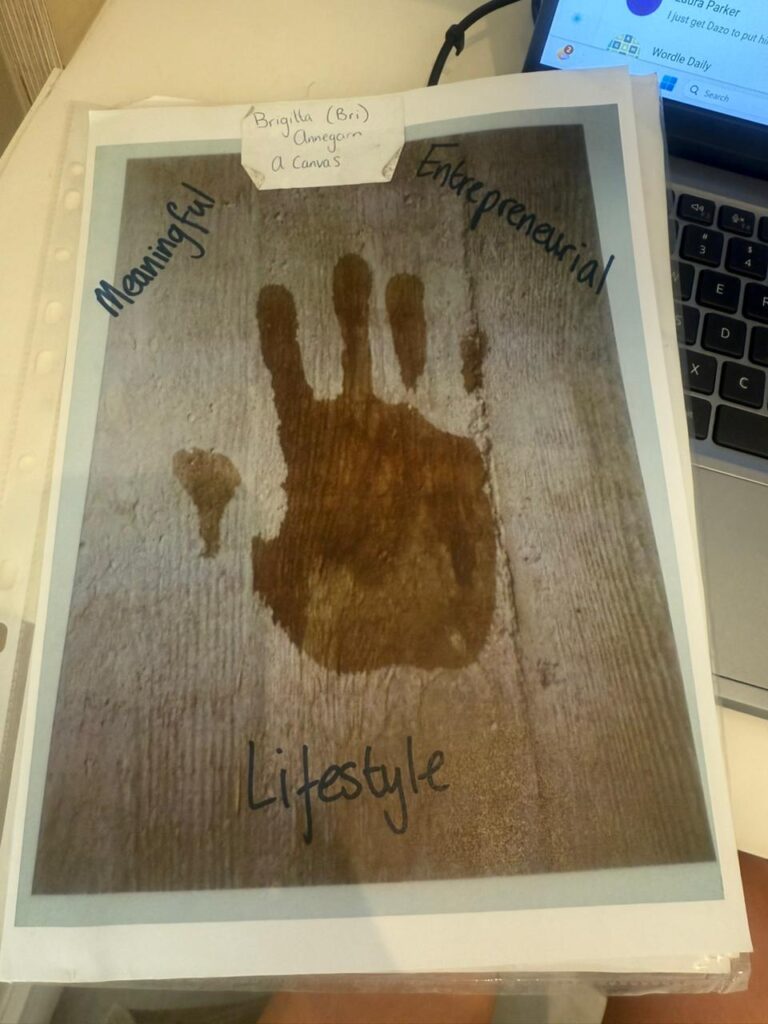
I found the piece of paper the other day. It had been folded into a file I hadn’t opened in years, from a Leadership course I took during my MBA. The exercise was simple, almost naive: write down what you actually want from your life. Not your career plan. Not your five-year projection. What you want.
I wrote three words: Lifestyle. Entrepreneurial. Meaningful (sic).
That was 2012. I stood in my home office holding this scrap of paper and had the strangest experience of being ambushed by my younger self. Because somewhere in the years between then and now, without ever ticking anything off, without a single moment where I felt I had arrived – I had achieved all three.
I’ve been thinking about that paper because of an article I read recently in PROVOKED magazine, about women in their fifties and sixties going fractional: stepping out of corporate structures that had stopped serving them and into portfolio careers as fractional executives. The piece frames it as a rebellion against being aged out, passed over, quietly sidelined.
My rebellion wasn’t because of age. My rebellion was because I wanted independence and control of my life. I didn’t wait until 50. I started positioning myself as a fractional leader at 35.
I didn’t wonder whether that was ballsy. I didn’t wonder whether I was too young to be selling senior leadership by the slice. I found this incredible gap that hadn’t yet been leveraged in the market and I went for it.
If I look at what I actually brought to the table: By 35 I had been a management consultant. I had corporate experience. I had built and run a small business. I had liquidated a business – which, let me tell you, teaches you things about cash flow, ego and hard decisions that no boardroom ever will. I had managed multi-million rand marketing budgets. I had two business degrees.
I wasn’t young in experience. I was young in years. And those are very different things.
The article is right that fractional leadership works because of what you’ve already lived through. Where I’d push back is on the assumption that the mileage only arrives with grey hair. Readiness isn’t a birthday. It’s a track record of having carried real weight and having the scars to prove it.
On entrepreneurial
Of the three words, this is the one that took me the longest to claim.
I built a business from scratch. I did the thing. And for years I still thought of entrepreneurs as other people – the ones on stage, the ones with the funding round and the origin story, the ones who clearly knew what they were doing. I was just over here in my corner, doing the work, watching them.
I don’t know exactly when that shifted. There wasn’t a moment. But at some point I stopped describing what I do in the passive voice. I built this. It exists because I made it exist.
If you’re reading this and you’re waiting to feel like an entrepreneur before you call yourself one, I want to save you some time: the feeling arrives long after the fact. Sometimes years after. Claim it early. You’ve earned it.
On meaning
The article makes a point I want to underline with a thick marker: not every organisation is ready for fractional leadership. Some are looking for a full-time hire at a part-time price, and they’ll dress it up in whatever language is fashionable.
The meaning, for me, came from being able to tell the difference, and from being able to walk away.
I have built a business that works with clients where there is mutual respect and genuine understanding of what we do. Where the leadership we bring gets used rather than tolerated. That freedom to decline the wrong engagement is, I think, the most underrated privilege of this model. In corporate, you don’t get to choose the culture you’re absorbed into. Here, I choose. Every time. And my team is given that freedom too.
On lifestyle
This is the word that would have embarrassed me most to say out loud in 2012, because it sounds like I wanted less. I didn’t want less. I wanted it arranged differently.
Today I have a business that is a going concern. It runs while I collect my children from school. It runs while I sit with them on weekday afternoons and hear about their day. I have built a team and a business model that doesn’t collapse when I step out of the room, and that is not an accident – it’s by design.
I get to be the mother I want to be. I also get to be the businesswoman that suits my personality and my ambition, rather than someone else’s template of what a serious career looks like. I refuse to accept that those two things were ever meant to be traded against each other.
So here’s what the paper taught me, standing there with 14-year-old handwriting in my hand.
I didn’t get here through a plan. I got here by being unreasonably clear, once, about what I actually wanted – and then making a long series of decisions that quietly pointed in that direction.
To the women reading this who are weighing up a version of the same leap: you don’t need to wait for a number. Not 50, not 60, not “once the kids are older,” not “once I’ve done another two years to be sure.” You need the experience to back yourself, the honesty to know which clients are ready for you, and the nerve to name what you want before you can see how to get it.
Write the three words down. Fold the paper. Then surprise yourself in 10 years.
Inspired by “Smart Women are Going Fractional After 50 — and Taking Control,” PROVOKED magazine.